Listed in: Starting up
Resilience blueprint: Nine steps to helping build a stronger business
This step-by-step resilience blueprint is a guide to help your business be better placed in the event of a crisis, now and in the future.
12 minute read

A ‘blueprint’ is a map or process which leads to an outcome – and in this case, our resilience blueprint is a step-by-step guide to help your business be better placed in the event of a crisis, now and in the future. Work through the steps in chronological order, implement as you go or skip to sections you think are the most relevant to you right now.
For an overview, take a look at the business resilience flowchart below and use our business resilience workbook pdf 157kb to help develop your plan of action.
Business resilience flowchart
Do you have any early warning systems?
No → Develop an early warning system
Yes ↓
Do you have the right support?
No → Build mental stamina and support
Yes ↓
Do you have cash reserves?
No → Creating a cash buffer
Yes ↓
Can you partner or collaborate?
No → Identify possible partnerships and grow your network
Yes ↓
Can you diversify?
No → Tapping into new markets
Yes ↓
Can you build capability?
No → Review and improve your capabilities
Yes ↓
Can you protect what you have?
No → Protecting your business
Yes ↓
Can you innovate?
No → Ongoing innovation
Yes ↓
Complete your business blueprint by documenting all the above. It’s also important to develop a timeline and cadence of work and actions to help future-proof your business.
Step 1. Develop an early warning system
When you’re running a business, there can be bumps in the road that are hard to plan for. Having alarm bells in place can let you deal with any issues and trigger action before things get out of hand.
Identifying your drivers
While sales revenue is often the best indicator of how well your business is performing, other drivers can help paint a clearer picture.
Here are some things that you could monitor regularly:
- Acquisition (fewer calls, queries, demos, meetings booked, foot traffic)
- Retention (customers switching to competitors)
- Average sale (cheaper competitors and discounts)
- Gross profit (increase in costs or selling lower margin items)
- Web traffic and leads (distracted customers)
- Conversion (fewer leads become customers)
- Accounts receivable (customers paying late)
- Unhappy employees (staff turnover, increase in sick leave)
- Social media participation (less relevance)
It’s important to remember that every industry has its own drivers. For example, builders may monitor new building consents, while retailers may look at foot traffic and inventory turnover, and farmers keep an eye on market prices.
Next steps
Choose which business drivers you want to monitor, set thresholds to trigger these warnings, and take action to improve them as soon as they deteriorate. Our articles on customer centricity as an online business and tactics to improve your profit margin outline a number of business drivers to consider.
Step 2. Build mental stamina and support
It’s no secret that everyone has moments of self-doubt. And with setbacks, disappointments, and challenges all being part of running a business, it’s important to have the right tools on hand.
Helping yourself
It’s important to develop and practice coping mechanisms, as well as having a good network to lean on and ask for help.
Try one or more of the following if your circumstances are stacked against you.
- Talk to family, friends, and people you trust.
- Reach out to other business owners with similar issues.
- Collaborate with complementary businesses to reduce the overall burden.
- Focus on small wins rather than trying to solve everything.
- Set short-term, achievable goals.
- Celebrate every success.
It’s also essential to take care of your physical and mental health, which could mean looking into external advice and support. Getting enough sleep, eating well, being kind to yourself, and prioritising your mental and emotional wellbeing can also help your mind and body be more resilient to change.
Reaching out
It’s rare for anyone to run their business without help or advice. A number of business support agencies are designed to help New Zealand businesses. A good starting point is to contact your local Regional Business Partner Network (RBP), who can outline the different government (and local council) support.
You could also access professional help from accountants or legal or specialist consultants. Alternatively, tap into mentoring from Business Mentors New Zealand with an external board of advisers, or access the support from your industry association or Chamber of Commerce.
If you need to talk, call Lifeline on 0800 543 354 (0800 LIFELINE), free text 4357 (HELP), or visit depression.org.nz to access a range of resources from the Ministry of Health’s list of mental health services.
Finally, if you know of another business owner struggling, reach out and ask if they’re ok and how you can help.
Next steps
Develop a series of actions to help you cope with the stress of being in business and seek help when you need it. Find a mentor or friend who has industry experience and a background in the solutions you need (such as increasing productivity, driving sales, or developing new products or markets). Read our articles on the five ways to reduce stress as a business owner and the importance of advisors for small businesses.
Step 3. Create a cash buffer
If sales fall while expenses increase, your profitability could be in danger. Having a cash reserve generally buys you more time to fix what needs fixing.
Finding cash within the business
Most businesses can squeeze extra cash by becoming more efficient, or altering how they do business, including:
- reducing the level of raw materials or inventory (use ‘just in time’ principles)
- clearing old or surplus stock (without re-ordering)
- selling unused or infrequently used assets (lease back if needed)
- renegotiating lower prices with all suppliers (don’t compromise on quality)
- collaborating with other businesses (to share resources)
- discounting outstanding customer invoices (or use a factoring company)
- conducting regular inventory audits to identify wastage
- asking suppliers if you can delay payments or pay in instalments
- requesting deposits or progress payments in advance
- switching from offering credit to immediate payments
- reducing fraud and theft.
Other more drastic cash saving measures might be needed. It could be time to scale back and remove the low profit-making parts of your business, or in some situations you might consider the need to close certain locations, branches, offices, or product lines to pocket that extra bit of money.
Finding new sources of capital
If you think your business has a bright future, and is just experiencing a short-term crisis, you may want to raise more capital. One option could be to use spare equity you have in assets, like real estate.
Bootstrapping
If you’re not able to raise new capital, you might be able to get what you need by bootstrapping.
Bootstrapping is a term used to describe the ability to find the resources you need for your business without borrowing money from financial institutions or raising external capital. This can include using your own money, borrowing from friends and family, accessing free help and advice, finding ways to collaborate with other businesses, low-cost marketing tactics, or waiting until the business is generating positive cash flow to re-invest.
Next steps
Decide how much cash you’d like in reserve, then build up this amount when you have money coming in. Read our articles on improving your cash flow and reducing your cash burn rate.
Step 4. Collaborating and partnering
Teaming up with other businesses to work towards common goals can be considered a smart way to increase capability and share resources, costs, and risks. The internet, sub-contracting, and having access to talent from around the world have made this even easier.

The collaboration opportunity
Working alongside another business gives you shared responsibility – you’ll have other colleagues to work with and rely on. If you face a crisis and can’t get your business back up and running in a short space of time, knowing you’ve got back-up from other companies can offer reassurance for both you and your customers.
Collaborating can help you:
- access new product/service lines
- develop new product knowledge
- block competition
- reduce costs
- fill expertise gaps in your business
- enhance capacity to bid on larger contracts
- strengthen customer and supplier relationships
- outsource production
- receive volume discounts
- speed up new customer development
- access new business models.
Partnering with other businesses can be formal (a contractual obligation), informal (verbal agreements), significant (sharing suppliers and long-term customers), or ad hoc (coming together as and when you need). When partnering with another business, always speak to an advisor and get professional help when setting things up. Check out this video to see how East Imperial’s approach helped them expand globally.
Finding the right partner
You’ll want to take care when considering which business is the right one for yours. Research and evaluate all potential partners thoroughly. Seek out companies that share your business ethic, strategy, and expectations of working together. And finally, get everything in writing – spell out roles and responsibilities like ownership, people involved, and everything in between.
Consider contacting your local Regional Business Partner Network (RBP). They could put you in touch with a business partner that’s right for you.
Next steps
Decide if collaborating works for your business by looking at what outcomes you’re after. You can watch our BNZ Connect Panel discuss why collaborating is the new competing or read about how to choose a business partner.
Step 5. Tapping into new markets
You’ll most likely have to market to new customers at some stage. This might be because of increased competition, slowing demand, new business models, or changing customer needs.
Target new customers in existing markets
There could be a number of new customers hidden in your existing market. Profile your ideal customer – demographics, the problem they want solved, where they spend their time, how they prefer to communicate with you and for business customers, their buying cycles, and then you could:
- target customers with similar needs to your existing profile
- find leads within your existing networks
- add content that solves customer pain points
- optimise your website with keywords for search engines
- collaborate with complementary businesses whose customers are similar to yours.
One way to be more effective in finding new customers is tracking what marketing tactics worked, like the ones listed above. And don’t forget to ask for referrals – your customers are likely to know other people just like them and are often willing to vouch for your business.
Diversify your business model
If you want to explore new ways of finding customers, consider widening your business model. Here are some ideas, using a coffee business as an example.
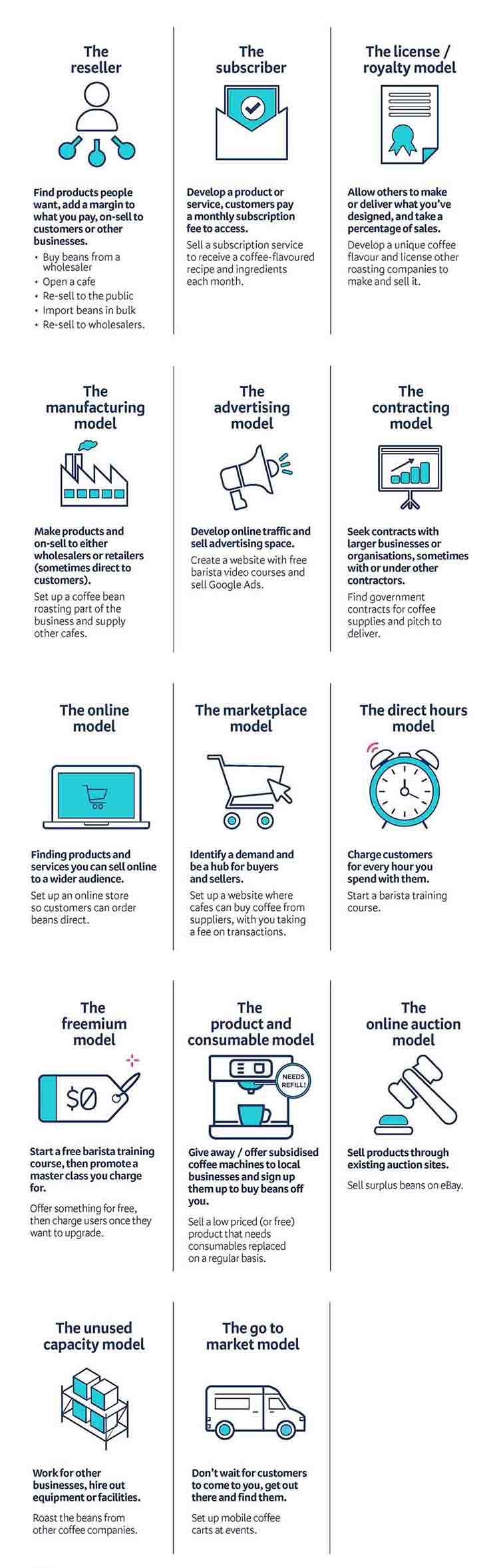
Ultimately any tactic that gets you in front of a new customer or opportunity can be worthwhile.
Next steps
Generate a list of practical tactics to add new customers that are relevant to your business and industry. Read our articles on driving online traffic to your website and using social media to build brand engagement.
Step 6. Build capability
When your business grows, you may consider scaling up production and infrastructure to match. You many need extra staff, larger premises, faster equipment, or different management skills to handle a business that could be two, three, or more times bigger.
Capability is your internal ability to run the business more efficiently, by having the right equipment, facilities, people, or resources on hand.
Ways to build capability include:
- adopting the latest technology to automate where you need
- implementing quality control systems to reduce errors or returns
- using suppliers who can keep up to speed with growth
- contingency plans to employ contractors to soak up demand
- having a premises or location that’s suitable for expansion.
Assess your ability to handle growth
To add capability, you’ll need access to resources to scale up, a management team with the time and expertise to grow, and a base of customers that can offer stable cash flow.
Think about what infrastructure contingencies you’d need in place if you experience exponential sales growth, and how you’d cope with sudden success.
Productivity will be increasingly important in this. You can look to make small improvements in how you accept orders, process work and make deliveries, which could all result in extra profit.
Maintaining the customer experience
More sales means more customer queries, complaints, calls, returns, and demands on your time. This means your customer experience should scale with your growth.
To help with this, you could delegate customer contact early to key employees, use customer relationship management (CRM) software to maintain communications, and even consider developing automated customer loyalty programs.
Next steps
Your customers are the most important part of your business, so it’s a good idea to document how you’ll manage an increase in activity while maintaining great customer service. Read our articles on using data to transform your business and how to hire the right people.
Step 7. Protect what you have
Existing customers tend to be more profitable and easier to sell to than trying to find new customers. It makes sense therefore to safeguard your current client base from possible competitor action.
Look to your strengths
Always consider the capabilities of your services, products, and customer experience. One way to feel confident is to audit your business to check you’re consistently solving the customer need, then take action to fix anything that needs addressing. This will help reassure customers they’ve made the right decision choosing your business.
Something else worth protecting is your reputation and credibility. It’s difficult for another business to mimic your unique style and industry experience. You could focus on being the expert, create industry content, blog, speak at well-known events, run webinars or podcasts, connect with industry experts, and use testimonials from high-profile customers.
Stay competitive
Focusing on retention can make it harder for another business to compete. You could see if you can:
- source unique products or services
- contract an exclusive trading area
- ask suppliers to only sell to your business
- be the only approved vendor
- set up formal referral agreements within your industry
- build a well-known brand
- top search rankings.
Protect your intellectual property (IP)
If there are parts of your business that are critical to your success, consider legally protecting and taking action if anyone breaches your rights. Your IP includes copyright, patents, designs, trademarks, trade secrets, and plant variety rights. Make a list of your business’ essential elements you can’t do without, identify if they can be protected, and then weigh up the cost of legal protection versus the possible loss if your rights are breached.
Protect your intellectual assets (IA)
An intellectual asset is a competitive advantage that usually can’t be legally protected, like your business contacts, networks, business know-how, and knowledge of what customers want.
You can protect these assets by having staff sign confidentiality agreements, only sharing information (like prices) with qualified leads, and limiting what you place online and in the public arena.
Discuss with your lawyer
Develop a list of actions to protect your business and customers from competitors, then visit the NZ Intellectual Property Office to get an overview of intellectual property. It’s also important to discuss with your lawyer to ensure you are protected.
Step 8. Ongoing innovation
Businesses that stand the test of time are often evolving and changing. For smaller businesses, the key to innovation comes down to listening to customers and looking for new ideas and ways to do business.
Modify your existing products or services
Whether you’re a baker, plumber, builder, or corporate professional, there are always ways to add something new to your skillset. The internet, apps, and growth of online shopping and banking have changed the playing field.
Taking for granted ‘normal’ online shopping, other ways of selling now include:
- third-party marketplaces
- digital payment platforms
- offering the core product to users for free and paying to upgrade
- drop shipping (another business holds the inventory and ships to your customer)
- renting short-term (using a scooter for 10 minutes)
- on-demand (delivering only when ordered such as printing and books).
This list isn’t exhaustive. Consider what is trending in your industry, and what you could take advantage of. Investigate if there’s a new selling strategy that opens up a new business channel to your customers.
Developing new products and services
If you need to find new products and services, you could follow this three step process.
- Research the customer problem and find out what customers need.
- Develop a prototype.
- Test it with customers.
You should also check you can sell your new product at the price or volume necessary to make a profit, and protect any intellectual property you’ve created to limit competition. Even better, you could involve customers in the design phase where and when needed.
It could also be worth looking up on trends online, look at research papers, and see what’s affecting your line of work.
Next steps
Stay up to date with what’s relevant to your industry and evaluate new software or channels. Read our article on how customer centricity can give you an edge and how tech can create business opportunities.
Step 9. Plan ahead
Thinking one, two, or three years down the line can help you better predict and react to changing business conditions.
Have a lean business plan
Use a lean business plan template PDF 37KB to sketch out the main components of your business strategy. This includes:
- the problems you solve for customers
- key customer segments
- your unique service proposition
- a solution to the problem
- the channels for your customers
- how you’ll generate revenue streams
- your cost structures and how to make a profit
- key metrics to measure performance
- your unfair advantage.
Putting ideas on paper is just the start, you’ll need to be committed to your plan to bring it to life. Work through the key milestones and steps you need to get there.
Review your long-term strengths, weaknesses, opportunities, and threats (SWOT)
A SWOT analysis helps you understand what you’re doing well (strengths), what you could improve (weaknesses), and which external factors could affect your business positively (opportunities) or negatively (threats).
Next steps
Stay on top of evolving information, focus on making sales and maintaining cash flow, reach out to people you trust, and work closely with your team to position a stronger business.
Once you’ve drafted your blueprint
Download our other useful tools and resources to help with resilience:
- Marketing strategy plan DOCX 280KB
- Funding plan PDF 36KB
- New markets and customers plan PDF 37KB
References to third party websites are provided for your convenience only. BNZ accepts no responsibility for the availability or content of such websites.
The information in this article is provided for general purposes only, and is a summary based on selective information which may not be complete for your purpose. It does not take into account your personal financial, legal or tax situation or goals and it does not constitute, and is not intended as, personalised financial, legal or tax advice. BNZ recommends that you seek advice specific to your personal financial, legal or tax situation from a qualified adviser. No representation or warranty is made as to the accuracy, reliability or completeness of any statement made in this article. Neither BNZ nor any person involved in this article accepts any liability for any loss or damage whatsoever which may directly or indirectly result from any advice, opinion, information, representation or omission, whether negligent or otherwise, contained in this article.