How increasing your contribution rate could boost your KiwiSaver savings
Small changes can make a big difference to your retirement. See how your KiwiSaver savings could grow faster when you increase your contribution rate.
5 minute read

Most people default to the minimum 3.5%* contribution rate when they join KiwiSaver, without realising the impact adding another 1% or more could have down the track. For most investors, KiwiSaver is a long-term investment, and time is on your side. Because of this, small changes in the amount you contribute along the way can make a big difference to your account balance when you reach retirement age.
Regular contributions add up to a bright future
Let’s take a look at the potential impact of different KiwiSaver contribution rates. We’ve based this example on a hypothetical KiwiSaver member called Ana.
Ana is 30-years old and currently earns $55,000 per year before tax. She has already saved $15,000 in her KiwiSaver account and has selected a Growth fund to save for her retirement. The assumptions used to calculate these projections are set out at the base of this article*.
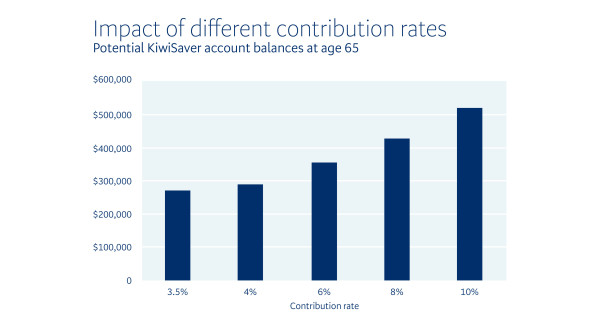
At age 65, Ana’s KiwiSaver savings could be worth $280,000 if left at the 3.5% contribution rate, but if she switches to the 4% rate now (at age 30), her savings could be worth $298,000 by the time she is 65. This increases up to $514,000 at age 65, if she chooses the 10% contribution rate at age 30. Depending on your situation, a manageable increase in contributions to your KiwiSaver account could make a big difference in the long term.
Every little bit helps
If you’ve looked at your own circumstances and found you’re able to maintain a higher level of KiwiSaver contributions, this could help set you up for a better retirement. It’s worth checking in to see how you’re tracking, as you may find you need to adjust your contribution rate to better suit your future plans.
Tip: Use our online calculator to see how your KiwiSaver savings might grow between now and age 65, and the impact your fund choice or contribution rate could have on your lifestyle when you retire. What’s more, you can see what impact some simple changes could have on your future account balance.
How do I change my contribution rate?
You can change your KiwiSaver contribution rate through your employer, your KiwiSaver provider or in myIR. You can change your KiwiSaver contribution rate once every 3 months, unless your employer agrees to a shorter timeframe.
For BNZ KiwiSaver Scheme^ members it’s easy to change your contribution rate in the BNZ app or Internet Banking. You can also check your balance, view transactions, and make voluntary contributions.
What if I’m self-employed?
If you’re working as a contractor, sole trader, or freelancer and not earning PAYE income, then you can still make regular contributions to your KiwiSaver account. Many self-employed people choose to set up a direct debit or automatic payment to keep their savings on track. You can choose your own level and frequency of contributions.
This will also help make sure you get the most out of the annual government contribution. That’s because just like all KiwiSaver members, you need to put at least $1,042.86 into your KiwiSaver account before 30 June each year, to receive the maximum government contribution of $260.72. You can find out more about government contributions and eligibility criteria here.
Taking control of your KiwiSaver account now could mean more money saved for your future goals. The more you contribute now, the more you’ll likely have to retire on when the time comes. Even small increases can really add up over time.
*The default minimum contribution rate for employees and employers has increased from 3%. This change is happening in two stages. The first increase from 3% to 3.5% took effect from 1 April 2026. The second increase from 3.5% to 4% will be effective from 1 April 2028. KiwiSaver members will be able to apply to IRD for a temporary rate reduction to keep their contributions at the current rate of 3%. Temporary rate reductions will be for a maximum period of 12 months, but members will be able to re-apply to IRD for further rate reductions. During a temporary rate reduction, employers may also contribute at the reduced rate of 3%.
Compare BNZ KiwiSaver Scheme Funds
Learn more
*Ana’s KiwiSaver account projections are for the purposes of illustrating the impact a different contribution rate can have on a KiwiSaver account balance at retirement and are based on several assumptions which are set out below in more detail. These hypothetical KiwiSaver account projections are therefore unlikely to reflect an actual KiwiSaver account balance at retirement. For example, actual investment returns are likely to move up and down due to investment and other risks. Returns may be negative over some time periods.
How this example works:
The value of Ana’s KiwiSaver account at age 65 is adjusted for inflation so you can see what her account balance would be worth in today’s money.
The results obtained in this example are not guaranteed to occur, and the example is simply an illustration to help you understand how choosing a different contribution rate can impact the value of your KiwiSaver account at age 65. The retirement projections in this example are based in part on assumptions for a Growth fund set by the Government. These assumptions may not reflect actual market conditions. A summary of the assumptions as used in this example is provided below, however, further details about the Government assumptions for retirement projections can be found on the Financial Markets Authority website.
The account balance projections calculated in this example are based on the following assumptions:
- Salary and wages assumed to increase by 3.5% each year and Ana's contributions are assumed to increase in line with her pay.
- Employee contribution rate is fixed at the rate shown. Employer contribution rate is fixed at the default contribution rate of 3%. Note: Projections do not account for scheduled increases to the default contribution rate in April 2026 and April 2028.
- No savings suspensions are taken.
- No amounts are withdrawn for first home purchase or financial hardship.
- Assumes eligibility for the maximum Government contribution of $260.72 every year until age 65 where income is $180,000 or less per annum. Note: Government contributions are calculated for the year 1 July - 30 June. Ana is considered ineligible for the Government contribution for any years where her income is assumed to exceed $180,000 per annum.
- Projections do not account for any voluntary contributions.
- The member remains invested in a Growth fund until age 65.
- The rate of return for the Growth fund assumes a positive rate of return each year of 4.5% p.a, which is stated after fees (using an industry average for the fund type that may not reflect actual fees) and after tax (using a prescribed investor rate of 28%). The projections are adjusted for inflation, and the inflation assumption is 2% perannum.
Internet access required for online banking and the BNZ app. BNZ Internet Banking T&Cs apply. Maintenance sometimes required.
References to third party websites are provided for your convenience only. BNZ accepts no responsibility for the availability or content of such websites.
This article is solely for information purposes. It's not financial or other professional advice. For help, please contact BNZ
or your professional adviser.
No party, including BNZ, is liable for direct or indirect loss or damage resulting from the content of this article. Any opinions in this article are not necessarily shared by BNZ or anyone else.