Should I split my KiwiSaver?
When it comes to investing, diversification plays a key role. Find out whether splitting your KiwiSaver could be the right thing for you.
4 minute read

You might’ve heard the saying, “don’t put all your eggs in one basket.” It’s a simple way of talking about diversification - making sure you’re not relying on one thing to deliver all the results.
When it comes to investing, diversification plays a key role. It means spreading your investments, for example, across asset classes, geographies, and sectors. That way, if one part of your portfolio doesn’t do well, the other parts could help you offset any losses - which could help to support your investment goals over time.
Many KiwiSaver funds are already diversified
A lot of people don’t realise that many KiwiSaver funds, including many of the funds in the BNZ KiwiSaver Scheme, already invest in a range of things - like shares, bonds, and cash. These investments are also selected from different parts of the world and across different industries. So even if you’re invested in just one BNZ KiwiSaver Scheme fund, your money is generally diversified, i.e. invested across a wide mix of investments and not tied to a single company, sector or geographic location.
Growth assets and income assets
Each BNZ KiwiSaver Scheme fund has a different percentage of growth and income assets, which determine the risk and recommended investment timeframe of the fund. This ranges from the Cash Fund with 0% growth assets and 100% income assets, all the way through to the High Growth Fund with 100% growth assets and 0% income assets. In most cases, this means you don't need to split your KiwiSaver investment as there should be a BNZ KiwiSaver Scheme fund with the right mix of growth and income assets to suit your needs.
Funds with more growth assets have the potential to produce higher investment returns over the long term, but they’ll have more ups and downs along the way (higher risk). Funds that have more income assets will likely be more stable (lower risk) but will generally produce lower returns over long timeframes.
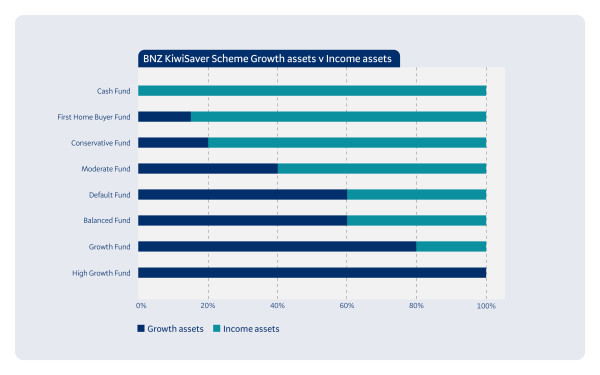
This shows the target asset allocation for each of the BNZ KiwiSaver Scheme funds. The actual investment mixes may vary, depending on market movements and other factors, within allowable investment ranges* .
When you might consider splitting your KiwiSaver account into multiple funds
For many people, a single BNZ KiwiSaver Scheme fund is simpler and just as effective, and there may be no advantage from splitting your BNZ KiwiSaver Scheme investment across multiple funds. Holding multiple funds can sometimes mean you have overlapping investments.
However, if you’re planning on withdrawing some of your KiwiSaver money soon, you could consider splitting into different “pots”, to line up with the investment timeframe and risk tolerance for each of your goals. In most cases, this means you don't need to split your KiwiSaver investment across more than one BNZ KiwiSaver Scheme fund to get the benefits of diversification.
Let’s take a look at some examples of when you might split your BNZ KiwiSaver Scheme investment, and when you might choose a single fund**.
Alex: Saving for a first home and retirement
Alex has just turned 30 and is focused on buying his first home. He’s planning to withdraw a large portion of his KiwiSaver money for a deposit in the next few years, but he’s also thinking ahead to retirement. To match his different goals and timeframes, Alex decides to split his KiwiSaver investment between two funds. He puts the amount he’s planning to use for his first home deposit in the First Home Buyer Fund, which has a minimum suggested investment timeframe of three years. The rest of his KiwiSaver savings – which he doesn’t plan to touch until retirement – he invests in the High Growth Fund. With time on his side, Alex is comfortable with more risk for his retirement savings (including more ups and downs along the way) and he wants the potential of the highest returns over the long term.
Rewi: Balanced investor with a single goal
Rewi is 45 and is saving for retirement. He reviews his investor profile using the Sorted risk profile tool, finding he has a ‘balanced’ investor profile. Rewi decides there’s no need for him to split his KiwiSaver investment into different funds, as all of the money has the same investment timeframe. Rewi chooses the Balanced Fund (which aims to achieve a medium level of return over the medium to long term) for his KiwiSaver money and reviews his contribution rate at the same time, to make sure he’s on track.
Grace: Planning a lump sum at retirement and long-term investment
Grace is in her early sixties and saving for retirement. She has worked hard to grow her KiwiSaver balance over the years and plans to make a lump sum withdrawal when she turns 65. However, she also wants to keep a significant portion of her savings invested for the long term. To manage this, Grace invests the ‘lump sum’ portion of her KiwiSaver money in the Conservative Fund, aiming for the potential of relatively stable returns over the next three years as she approaches retirement. Meanwhile, she keeps the remainder in the Growth Fund, as it aligns with her longer-term investment horizon and risk tolerance.
Keeping it simple
KiwiSaver is designed to make investing for the future easy and accessible. Choosing a single, well-diversified fund that aligns with your risk tolerance and investment timeframe could provide the simplest and most effective approach. However, everyone’s situation is different, so it’s important to do what’s right for you. Regularly review your KiwiSaver account and contributions to ensure they continue to support your financial goals.
Related articles
Choosing the right KiwiSaver fund for your life stage
KiwiSaver isn’t set-it-and-forget-it. Find out the importance of regularly reviewing your KiwiSaver fund choice, and the best times in life to do it.
Seven investing hacks to help supercharge your savings
The world of investing can sometimes seem overwhelming, especially if you’re just getting started or don’t have a background in financial markets. These investing hacks are designed to give you the tools and knowledge to help you on your investment journey.
What is investment ‘risk’?
Risk, like returns, is an everyday part of investing. In this article, we cover what it is, what it can mean for investors – and how to factor it into your investment choices.
Compare BNZ KiwiSaver Scheme Funds
Compare KiwiSaver funds
*For more information about the allowable investment ranges please see the Statement of Investment Policy and Objectives
**Fictional examples are provided for illustrative purposes only.
This article is solely for information purposes. It’s not financial or other professional advice. For help, please contact BNZ or your professional adviser. No party, including BNZ, is liable for direct or indirect loss or damage resulting from the content of this article.